
Introducing my new assistant, Jasmine Rose
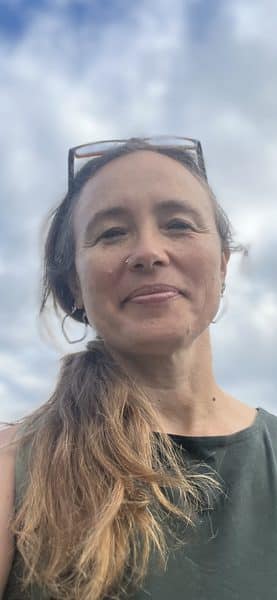
Since the beginning of September, I’ve had the privilege of working with Mary Fox in her studio in Ladysmith on Vancouver Island. Mary brings decades of experience to her work, along with an exquisite level of skill and a continuing commitment to exploration and experimentation. It is an honour to have the opportunity to learn from her, to work in her space, and to observe the knowledge and experience she brings to the process. One thing I particularly appreciate is the combination of deep technical understanding and an openness to discovery and I enjoy the opportunity to explore ideas together through conversation, experimentation, and a shared sense of curiosity.
My first experience with clay was at the San Francisco Montessori School, where I attended elementary school. We had two wonderful art teachers both named Karen who introduced us to a wide variety of materials and art forms including handbuilt pottery. Growing up in San Francisco in the late 1970s and ’80s, the art room at school was a place where I felt a sense of spaciousness and openness , an invitation to explore. As a somwhat shy kid, I felt seen by my teachers at the San Francisco school.
I returned to pottery several times over the years, including a focused stint in my twenties at a wonderful small studio in the Castro in San Francisco. But it wasn’t until I moved to the Cowichan Valley and discovered the Clay Hub Collective that pottery became a more consistent part of my life, first with weekly classes, and in recent years, as a full-time practice.
Even during the years when I wasn’t making pottery, I have always loved handmade ceramics and was especially drawn to certain colours and textures. surfaces. At the time I didn’t yet have the language to describe my favourite work, which I now recognize as the results of atmospheric firing.
My favourite way to fire my work is in atmospheric firing – high-fire gas reduction, soda, and wood firing, as well as raku and smoke firing. I’m excited to get to know Mary’s approaches ot firing with her Blaauw kiln and especially to explore the low fire reduction she writes about in her second book, Developing Glazes.
Over the years, I’ve sought out opportunities to learn and work with atmospheric techniques whenever I could, including a focused residency in Berkeley, California where I trained in gas kiln and soda firing, and a number of trips to the Shadbolt Centre in Burnaby for both soda and wood firing. I’m also a member of the the Tozan Community in Cedar, near Nanaimo- a volunteer-run noborigama wood-fired kiln, built into a hillside in the tradition of Japanese traditional kilns based on the even more ancient Chinese dragon kilns. Firing with the Tozan community is a collective undertaking, often with 30 to 40 members working together chopping wood in preparation and then taking six-hour shifts around the clock to tend the fire. One of the things I love about atmospheric firing is the balance between intention and uncertainty. We bring our learning and experience, but we also remain open to what happens. Focusing on atmospheric firing, I co-founded a gallery show now in its 3rd year called “The Art of Atmospheric Fire” showing from Nov 18 – Dec 15 at the Cowichan Valley Arts Council in Duncan, with an opening celebration on Sat, Nov 21 from 1-3pm – everyone welcome!
I’m looking forward to seeing what emerges from this time working with Mary, and how it influences my practice of and relationship with clay.
 The studio sale is fast approaching and there is much to be done. It’s time to dig out the seconds…
- Been years since I've made canisters and it's safe to say I've never made a her and his set. A…
 The Mary Fox Legacy Project is pleased to announce a new initiative: Legacy Studios. I have to say that this…


